Electrical Wiring in Bathhouse, Garage, and Cottage. Schema.
Electrical Wiring on a Cottage
A cottage is often a wooden structure, and most of the work in it is done by the owners themselves. If the owners of a cottage decide to install the electrical wiring on their own, they need to know how to properly wire the cottage.
For wooden structures, concealed wiring in metal pipes is acceptable, but for a cottage, this option is too expensive. Therefore, electrical wiring on a cottage is installed openly.
The cheapest way is to run the wiring in special cable channels. If a cottage is a fully equipped country house, open wiring on insulators can be chosen. The wires and electrical installations for retro wiring are quite expensive, so it makes sense to do such wiring in a living house.
Wires for cottage wiring are selected with enhanced insulation, non-flammable and low-smoke. The principles of how to make an electrical connection into a cottage are the same as for any wooden house.
It should be remembered that only copper wires are used on wood. If aluminum SIP is chosen for external wiring, it cannot pass through wooden walls: the branch from the power line is made to the walls of the cottage, and the actual connection is made with copper cable joined to aluminum using special clamps.
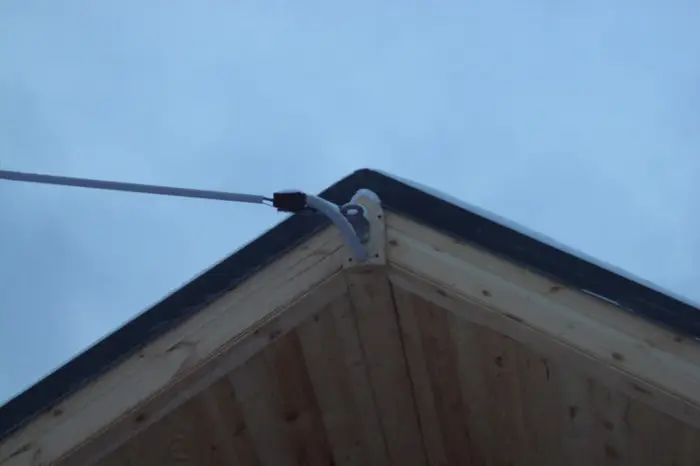
Photo 1 – External Wiring on a Cottage
Electrical Wiring in a Garage
There is nothing new in how to install electrical wiring in a garage by oneself compared to external and internal wiring in houses.
To plan how to bring electricity into a garage, a wiring diagram is made. The installation of the cable into the garage and its connection to the distribution board should be handled by a professional electrician.
Internal wiring is concealed if the walls are made of brick or concrete. In such cases, grooves are cut into the plaster, wires are placed in them and then covered with plaster, matching the wall color. On metal garage walls, wiring is mounted openly.
Due to the use of powerful appliances in a garage, such as a welding machine, appropriate wires and outlets must be selected. The cross-section of the wires leading to consumers is calculated based on their power. Outlets can be purchased splash-proof – with a cover. The wiring must be thoroughly protected from moisture. It is necessary to ensure grounding and RCD (Residual Current Device).
Electrical Wiring in a Garage, Video:
Electrical Wiring in a Bathroom
There are several mandatory rules when installing electrical wiring in a bathroom by oneself.
- Distribution boxes and switches should not be located in the bathroom: they should only be placed in the hallway.
- Outlets in a bathroom are also undesirable: if installed, they must be splash-proof and only in the third zone (as shown in the diagram below).
- The wire to a light fixture is run from the distribution box in the hallway through an opening in the wall. In small bathrooms, a light fixture is usually placed above the entrance door. Electrical wiring in a bathroom, as in a damp room, should be minimal. The wire to the light fixture is run along the shortest path.
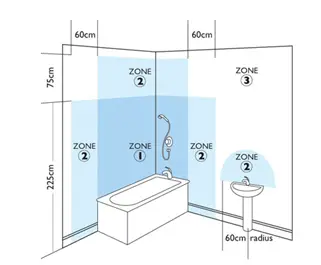
Diagram 1 – Outlets in a Bathroom Can Only Be Placed in Zone 3
Electrical Wiring in a Bathhouse
The question of how to install electrical wiring in a bathhouse by oneself is even more complex. Recommendations for installing electricity in wooden houses and bathrooms are also applied to the installation of electrical wiring in a bathhouse.
The installation of electrical wiring is complicated by the fact that, in addition to a flammable base and moisture, there is also a strong thermal factor. It should be remembered that wiring cannot be installed above the stove. The wire must be non-flammable and heat-resistant.
As in a bathroom, electrical installations should not be installed directly in the steam room. Distribution boxes, outlets, and switches with high protection ratings should be mounted in the vestibule. A light fixture for the steam room must have a minimum protection rating of IP-44. Low-voltage light fixtures can also be installed, accordingly with a step-down transformer.
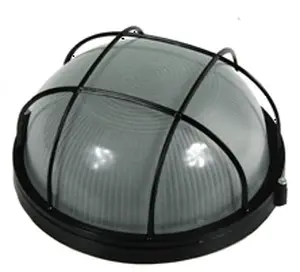
Photo 2 – Suitable Light Fixture for a Bathhouse – Glass Cover, Metal Base