Decorative Facade Stucco: Variety and Technology
Decorative stucco for facade can be special facade stucco, baseboard stucco, or universal stucco suitable for both external and internal works. Stuccos differ depending on the main component. Mineral stucco is the most durable and cheapest. The main component of such stucco is cement. It is well-suited for decorative finishing of the external parts of buildings due to its properties. Usually, after applying mineral stucco, facade paint is required for coloring, as the color options of the stucco itself are limited.
Decorative Facade Stucco
Decorative stucco for facade can be special facade stucco, baseboard stucco, or universal stucco suitable for both external and internal works. Stuccos differ depending on the main component.
- Mineral stucco is the most durable and cheapest. The main component of such stucco is cement. It is well-suited for decorative finishing of the external parts of buildings due to its properties. Usually, after applying mineral stucco, facade paint is required for coloring, as the color options of the stucco itself are limited.
- Acrilic stucco is more elastic. Due to this, it is less prone to cracking. At the same time, it protects against moisture accumulation and has good vapor permeability, and is resistant to temperature fluctuations. Facade cladding with acrylic stucco is convenient because it comes as a ready-to-apply mass, packaged in buckets.
- Silicate stucco is made from liquid glass. Its advantage is that it does not attract dust and dirt, and can be used for finishing various walls.
- Silicone stucco is characterized by a wide color range, high elasticity, self-cleaning properties, and high cost.
Article on the topic: Types of stucco.
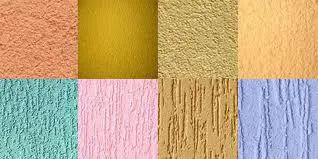
Photo 1 — Decorative Stucco for Facade
Technology of External Finishing
Facade finishing with stucco can be done over insulation, for example, polystyrene.
There is a specific system of insulation or external finishing technology called the "wet facade".
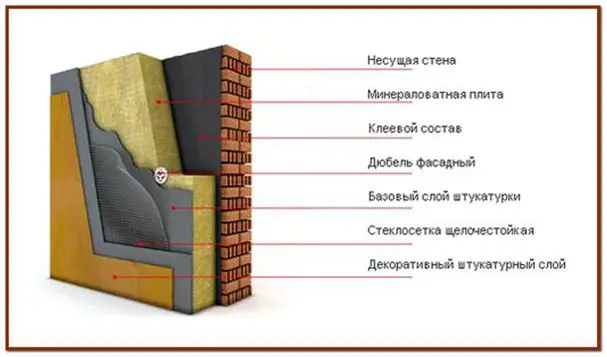
Photo 2 — Facade Finishing with Stucco
Most Popular Patterns
So, the facade is prepared for stuccoing, and now it remains to choose color and pattern, or rather, the texture of the stucco. Regarding color, there are two options: to apply the stucco and then paint it in the desired color (as with mineral stucco) or to buy, for example, acrylic or silicone stucco in the desired color. The surface relief depends not only on the stucco application technique but also on the size of the aggregate particles in the stucco. There are several popular types of patterns.
- Corroded pattern. Due to the structure of the stucco mixture, a pattern with depressions and grooves is formed. The Corroded pattern is applied using a stainless steel rake, and the pattern is shaped with the same rake as it dries. The resulting texture will depend on the trajectory of the rake across the stucco.
- Sheep pattern or stucco "under fur". This is one texture but with different materials and application methods. The classic "fur" is made with a cement-sand mixture using a stick and broom, mesh, or a shaggy applicator: the even-textured surface is achieved by the application method. Stucco "sheep pattern" can have a different composition and is applied with a trowel. The surface texture is created by the graininess of the mixture itself.
- Rustic texture – grooves and ribs on stucco, for example, imitating stone masonry. Facade repair can be done by yourself.
Decorative Facade Stucco, Video:
However, one thing is applying stucco or painting a facade yourself, and another is a full set of external finishing, for example, the "wet facade". Nevertheless, both are better left to professionals. Even a small cost of the work may end up cheaper than the cost of redoing the job after personal experiments. Pricing for stucco work varies. You can find out how much a certain type of work costs on construction company websites.
- Facade stucco – price in Moscow from 400 rubles per square meter.
- Facade stucco – price in Kiev from 80 hryvnia per square meter.