Painting gypsum board for all types of surfaces: ceiling, walls, openings
Gypsum board for painting: preparation
It is a mistake to only spackle the joints of GKL sheets (see photo below), leaving the entire surface of the sheet unattended: in such a case, the base color will show through to the finish coating.
The correct way to prepare gypsum board for painting is as follows:
- GKL sheets are primed;
- joints between sheets are spackled;
- the entire surface of the sheets is spackled;
- the entire surface of the sheets is sanded.
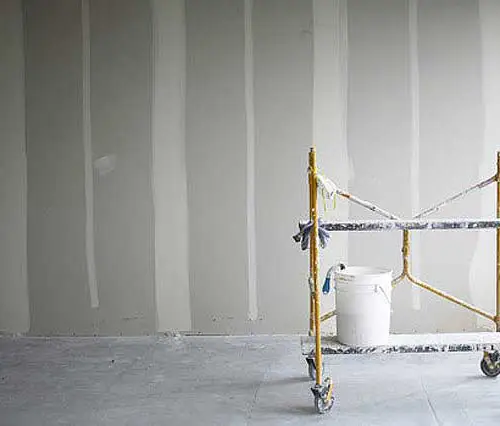
Photo 1 — Spackling the joints of GKL sheets. Preparation of gypsum board for painting should not end here
Paint for gypsum board
Gypsum board can be painted with:
- alkyd enamel paint;
- water-emulsion paint;
- water-dispersed paint.
Differences between various types of paint
Water-emulsion paint consists of two emulsions in which tiny oil particles are diluted but not dissolved in water, i.e., liquid in liquid. After drying, water-emulsion paint usually lightens by a couple of shades.
Painting walls with this type of paint gives a matte surface. Usually, it is only available in white color, and coloring requires additional pigment. These paints are generally not recommended for walls in humid rooms (using gypsum board in such rooms is also discouraged unless you purchase a special type of GKL sheets).

Figure 1 — Technical characteristics of some paints
Which water-emulsion paint to use? For example, SADOLIN BINDO 20 water-emulsion paint by Sadolin Bindo 20 (semi-matte) $15/1 liter (consumption: 6–8 m²/liter).
Water-dispersed paint, on the other hand, is paint based on water dispersions of polymers — solid in liquid. Solid particles of the material adhere to the surface upon application, forming a strong film. This type of paint is moisture-resistant, resistant to dirt, and importantly, it dries quickly.
Which water-dispersed paint to use? For example, Scanmix ECO DELUXE interior water-dispersed paint $12/10 liters (consumption: 2.5 dm³ per 12.5 m² in one layer).
Enamels dry quickly and are also moisture-resistant. However, these types of paint work best on elements with higher load or wear (e.g., arch joints).
Which enamel paint to use? For example, white Sniezka enamel paint costs $5/0.8 liters (consumption: 12 m²/liter).
The choice of paint should be justified by the conditions of future surface use and room environment: painting walls in a kitchen requires more durable paint (dispersed), while painting gypsum board in inter-room arches can be done with emulsion paint.
IMPORTANT! When selecting paints, pay attention to product labeling and intended use. All three paint types are available for both interior finishing work and external surface painting (façade).
POPULAR QUESTION: Can you paint gypsum board in one layer?
No. To achieve beautiful walls or ceiling, at least 2–3 layers are required.
How to paint gypsum board with water-emulsion paint?
Water-emulsion paint is usually diluted with water before application on wall surfaces (the required proportions are specified by the manufacturer on the label). Often, water content in paint does not exceed 5–10%.
Tools for the job
- water-emulsion paint;
- painter's tray;
- construction mixer with special attachment;
- scaffold;
- various-width brushes;
- long-bristled roller;
- painting tray;
- personal protective equipment (glasses, gloves, long-sleeved work clothes).
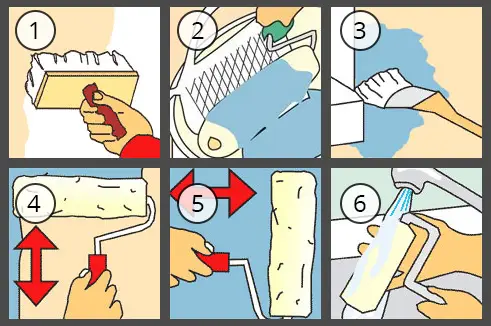
Figure 2 — Painting gypsum board: 1 – surface priming; 2 – paint preparation for work; 3 – painting corners; 4, 5 – first vertical and second horizontal paint layers; 6 – cleaning tools from paint
IMPORTANT! Painting walls must be done with the same tool: due to different reflectivity of the same rollers or brushes, using different tools can result in an uneven surface.
Work rules
Gypsum board is primed with primer for highly absorbent surfaces (e.g., TIFENGRUND KNAUF primer, $19/5 liters, consumption: 100 mm/m²).
During work, the roller should not be turned over: painting walls is done with one side of the roller across the entire painted area.
Do not proceed with re-painting surfaces where paint has started to set but is not yet dry.
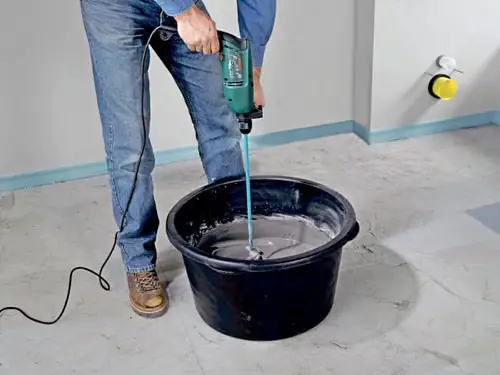
Paint must be mixed before application on walls (use a construction mixer with special attachment).
Painting walls starts from corners: small brushes are used to paint the edges where ceiling (floor) meets the wall, as well as in other hard-to-paint areas with a roller.
IMPORTANT! On ceiling and floor in areas adjacent to painted walls, if surface contamination is undesirable, wide painter's tape should be applied.
Dip the roller into a container with paint, removing excess from the tool using a special mesh.
The question of whether it is possible to paint a wall made from gypsum board in multiple layers in the same direction has an unambiguous answer: no. If the first layer is painted vertically, the second must be done horizontally. When painting walls in three layers, the process is similar: vertical – horizontal – vertical.
Each type of paint has its own drying characteristics. As for emulsion, the top layer usually dries in 1–2 hours. The second layer is applied after 3–4 hours.
All technical details of painting walls with a particular paint type are indicated by the manufacturer on the product packaging.
Painting gypsum board: VIDEO
$ Paint for gypsum board: price considerations
Material costs:
- Johnstones Acrylic Eggshell acrylic emulsion paint $61.8/5 liters;
- CAPAROL DecoLasur Matt matt lasure water-dispersed paint $156/10 liters;
- TIKKURILA Miranol alkyd enamel by Tikkurila Miranol (high-gloss) $136/9 liters.
Painting work on gypsum board:
- In Moscow – $110/m²;
- In Kiev – from 25 UAH/m².