Shuttering Material Consumption per Square Meter
By composition, they are divided into dry — mineral (cement-based) plasters and ready-mixed — acrylic, silicone, and silicate plasters.
Types of Plaster
By composition, they are divided into dry — mineral (cement-based) plasters and ready-mixed — acrylic, silicone, and silicate plasters.
By purpose, they are divided into leveling (not final) and decorative.
It's important to distinguish between material consumption and solution usage during repairs. The approximate consumption of ready-mixed plaster per 1 m² is clearly indicated on the packaging for all types. However, the consumption of dry mix (what you initially purchase) still needs to be calculated.
IMPORTANT! The difference in values can be significant, because when specifying consumption of ready-mixed plaster per 1 m², both the plaster itself and the volume of water used in its preparation are taken into account.
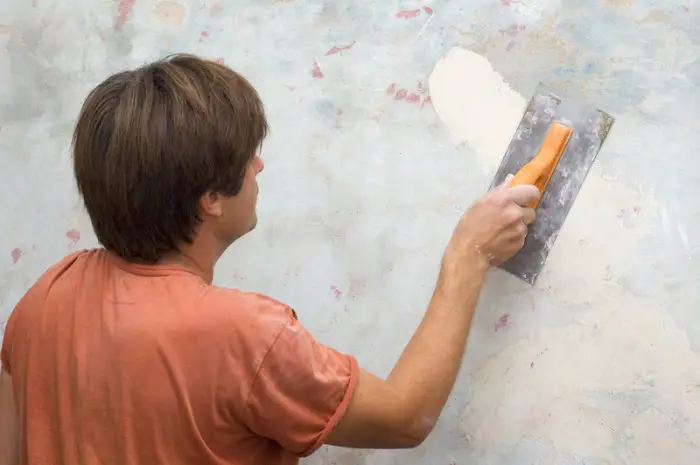
Photo 1 — Plaster Application
Plaster Calculation: General Information
First methodTo calculate the amount of plaster needed for repair work, you need several parameters:
- Wall area (m²);
- Wall curvature measurement (mm, i.e., plaster layer thickness);
- Yield of ready mix (liters per kg, see on packaging).
The accuracy of measuring the first two parameters is crucial: some types of plaster cannot be applied in thick layers (if wall curvature or required layer thickness exceeds 30–40 mm), and even if used up to 50–70 mm, only with reinforcing mesh or other strengthening materials.
IMPORTANT! The consumption of ready-mixed plaster on packaging is specified per 1 mm layer thickness. As known, only thin-layer plasters can achieve the desired result and level surfaces with just a few millimeters. Most plasters are applied between 5 mm and 70 mm. Adjust the manufacturer’s consumption value to match your actual layer thickness.
For example:
- WOLMA-Sloy gypsum plaster, applied at 1 mm thickness, weighs approximately 8–9 kg (manufacturer recommends using this type for surfaces from 5 to 30 mm), but in minimal layer it reaches about 40 kg per square meter;
- WOLMA-Plast gypsum-based plaster, applied at 1 mm thickness, weighs about 10 kg/m², thus 50 kg/m² at 5 mm thickness.
These figures help not only estimate the required quantity of ready-mixed plaster for wall leveling, base preparation for wallpapering or painting, but also estimate weight — additional load on load-bearing structures. This is another critical value not to overlook. Why? Some walls simply cannot withstand the weight of plaster, risking at minimum cracking of the coating, and at worst, structural damage.
Weight, like consumption, also depends on the type and composition of the plaster.
Returning to calculations for dry mix needed for wall repair.
First method for calculating dry mix consumption uses the formula:
С = (S × d) / V, where
- S − area of the surface to be plastered;
- d − thickness of the plaster layer;
- V − yield of the final solution (indicated on the label).
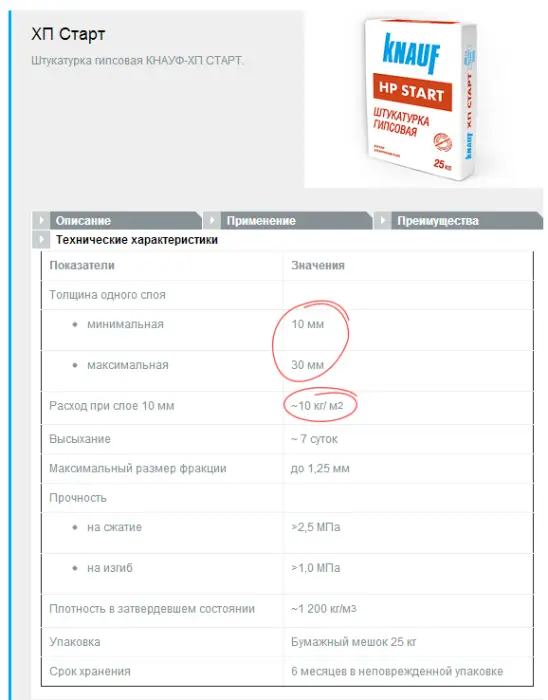
Photo 2 — What to Pay Attention To
Second methodThe required amount of plaster can also be calculated differently. From data on the packaging, we know the consumption of ready-mixed plaster and the amount of water used in its preparation.
To calculate how much dry mix is needed for plastering a given example room (see below), we calculate:
IMPORTANT! Only for water does 1 liter = 1 kilogram, so step 3 can be done without additional calculations.
Plaster Solution Consumption for Wall Plastering
Let’s calculate consumption for the most commonly used dry plasters. For example, a standard room of 3 by 4 meters with wall height 2.65 m.
Cement Plaster: Mix Consumption
One of the most popular materials for wall plastering — cement plaster (cement-sand, cement-lime). Cement plaster consumption defines three other types: rich/normal/lean, and classification of cement plasters by weight into light and heavy (density over 1,500 kg/m³). Cement-lime mixtures are more commonly used due to their weight and drying speed. Average cement plaster consumption is 1.2–1.6 kg/m². Gypsum plaster is lighter: consumption is 0.9 kg/m².
INTERESTING: There exists a special radiation-protective plaster — barite plaster, with consumption of 2.2 kg/m² at 1 mm thickness (water content — 0.21 l/kg). Price: from $19.7 per 25 kg.
Plaster Consumption per m²: Manufacturer Data
Stareli Universal − 1.1 kg/m² (30 kg bag, $6.5 per pack);
Ceresit CT 24 (Ceresit) − consumption is 1.2 kg/m² (25 kg bag, $7 per pack);
TEPLON-Koroed decorative, thermal-insulating − 1.52 kg/m² (25 kg bag, $15.9 per pack);
Herkules − 1.67 kg/m² (25 kg bag, $3.8 per pack).
For comparison: NR Start KNAUF (KNAUF, gypsum plaster) − 1.58 kg/m² (25 kg bag, $3.5 per pack).
For comparison: gypsum plaster Rotgips contains about 1.15 liters water per 1 kg ready mix, consumption is 1 kg/m², price from $7.65 per 30 kg.
Yield of final solution (V), if not indicated on the label, is calculated from provided data. For example, Ceresit CT 24 25 kg packaging requires about 5.5–6.0 liters. Thus, water needed for 1 kg mix is 0.22 liters.
Thus, final solution yield (V) for each brand:
- Stareli − 0.26 l/kg;
- Ceresit CT 24 − 0.22 l/kg;
- TEPLON-Koroed − 0.18 l/kg;
- Herkules − 0.6 l/kg dry mix.
For comparison: NR Start KNAUF − 0.6 l/kg.
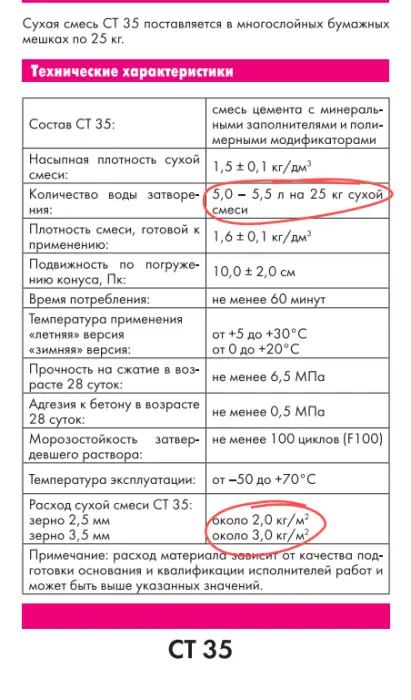
Photo 3 — What to Pay Attention To
Plaster Consumption CalculatorLet’s calculate the work area.
With two walls at 3 and 4 meters and wall height 2.65 m, total wall area is 37.1 m². Subtract area of a typical window (120 by 140 cm, i.e., 1.68 m²) and interior door (90 by 180 cm, i.e., 1.62 m²), resulting in 33.8 m² for plastering.
Given:
S − 33.8 m²;
d − 5 mm (note: layer thickness varies by plaster type and surface, so we use average value);
V − values above.
IMPORTANT! All values must be converted to SI units during calculations!
Wall Plastering: Dry Mix ConsumptionMathematical calculation yields dry mix consumption for 5 mm layer:
- Stareli − 137.6 kg dry mix, i.e., 4.6 bags;
- Ceresit CT 24 − 158.19 kg dry mix, i.e., 6.3 bags;
- TEPLON-Koroed − 210.64 kg dry mix, i.e., 8.4 bags;
- Herkules − 112.6 kg dry mix, i.e., 4.5 bags.
For comparison: NR Start KNAUF − 106.78 kg dry mix, i.e., 4.2 bags.
Estimated cost for these materials:
- Stareli − $29.9;
- Ceresit CT 24 − $44.1;
- TEPLON-Koroed − $133.56;
- Herkules − $17.1.
For comparison: NR Start KNAUF − $14.7.
Decorative Plasters: ConsumptionWith decorative plasters, it’s much simpler. Water content in finished decorative plasters (acrylic, silicone, silicate) averages up to 250 ml per 25 kg, and some types require no water addition. Thus, the consumption per square meter indicated on packaging can be used directly when purchasing.
For example, FEIDAL Reibeputz "cicada" textured plaster costs $22.75 per 8 kg (or $69.71 per 25 kg), consumption is 2–4 kg/m². Up to 5% volume increase is possible by adding pigment. Consumption for finishing the example room would be approximately 8.45–17 bags of 8 kg, or 67.6–135.4 kg, i.e., 2.7–5.4 bags of 25 kg. Decorative plaster is expensive, but the result justifies the cost. For finishing a standard room with FEIDAL Reibeputz "cicada", material cost ranges from $192 to $386.
Cost of Plastering Work
- In Moscow − from $160/m² for leveling plaster and $340–$450/m² for decorative (depending on type and texture complexity);
- In Kyiv − from $40/m² for leveling plaster and $80–$114/m² for decorative (depending on type and texture complexity).