Roof Trusses for a Sloped Roof
The role of the truss structure in any pitched roof cannot be overestimated: trusses form the skeleton of the entire structure, bearing wind, snow, and other loads, and distributing them along with the roof's weight across the building's load-bearing perimeter. The design and method of truss construction depend on the roof's shape, attic floor, and placement of vertical supports.
Trusses are generally divided into three main types: sliding, hanging, and inclined. Let's examine the functional purpose of each type in more detail.

Types and Applications of Truss Systems
Sliding trusses are mainly used in log cabin roofs to compensate for wood shrinkage in the first season after the cabin is erected. They are named for their support only on the ridge member (beam or log), with connections to walls made via simple sliding mechanisms. These mechanisms allow free movement of the truss member during wood shrinkage and ensure secure fixation at all other times.
The main feature of inclined trusses is that they rest on the wall plate or directly on load-bearing walls at one end, while their upper ends are connected to each other via a ridge beam, which in turn is supported by special vertical posts, diagonal braces, and diagonal struts. The most common spacing between two inclined trusses ranges from 0.8 to 1.4 meters.
The most complex type of truss construction is the hanging system. Its primary structural element is trusses—more precisely, a combination of trusses made of steel rods connected to each other and lying in the same plane. The entire system rests on two (or more) external load-bearing walls, while internal rods form a lattice-like structure.
Inclined Trusses for a Single-Pitched Roof
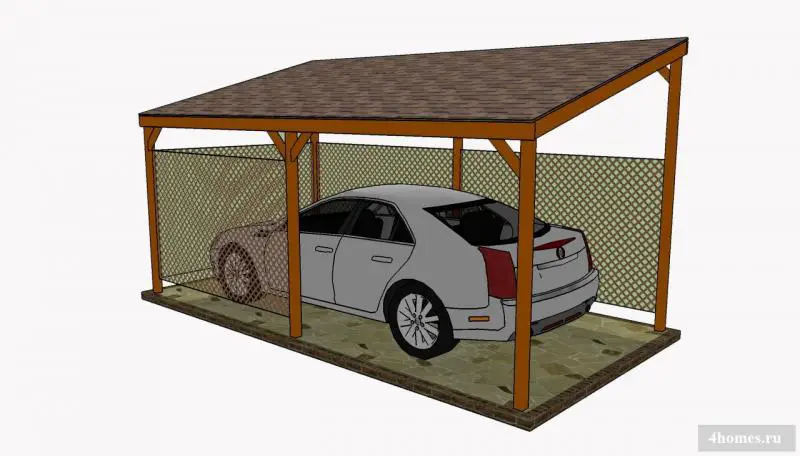
For a single-pitched roof, inclined trusses are the most convenient and cost-effective solution. The single roof slope should be oriented to the windward side to protect against diagonal rain in warm seasons, prevent snow eddies in winter, and improve resistance to maximum wind loads.
The optimal span between load-bearing walls is 4.5 meters (or less, depending on the structure). In this case, inclined trusses can be directly supported on a wall plate (also known as a plate beam) fixed along the top edge of load-bearing walls. The wall plate is a support beam with a cross-section of 100 x 200 mm.
If the span between load-bearing walls exceeds 4.5 meters, inclined trusses cannot be installed without additional support due to the risk of structural collapse under high snow and wind loads. In such cases, an intermediate support is typically installed, and the trusses, in addition to resting on this post, are further reinforced with so-called diagonal struts (kossynki). This solution significantly reduces the load on the truss system and simplifies roof installation.