The hallway is turning into a storage area: items that don’t fit by the door
The foyer has a fairly simple purpose: to help people exit the house quickly and return just as quickly. It should provide a convenient place to remove outerwear and shoes, as well as a spot for keys and other items needed before leaving. If one has to move things around, step over boxes, or search for an empty hook every day, the problem isn’t necessarily the small space. It’s more likely that too many items that aren’t meant to be stored at the entrance have accumulated there.
Keep Only Current Season’s Items by the Door
A jacket that is worn almost every day, along with one or two pairs of shoes suitable for the weather, should indeed be readily available. But when winter boots are added in September, along with several coats, summer sandals, and shoes for situations that haven’t yet arisen, the entryway quickly stops being convenient.
It’s better to focus here not on a strict number of items, but on how easily they can be accessed. If you have to move three other pairs of shoes aside just to get the one you need, and if the coats are hung in layers and get tangled with each other, then some of the items are taking up space not usefully but rather hindering use.
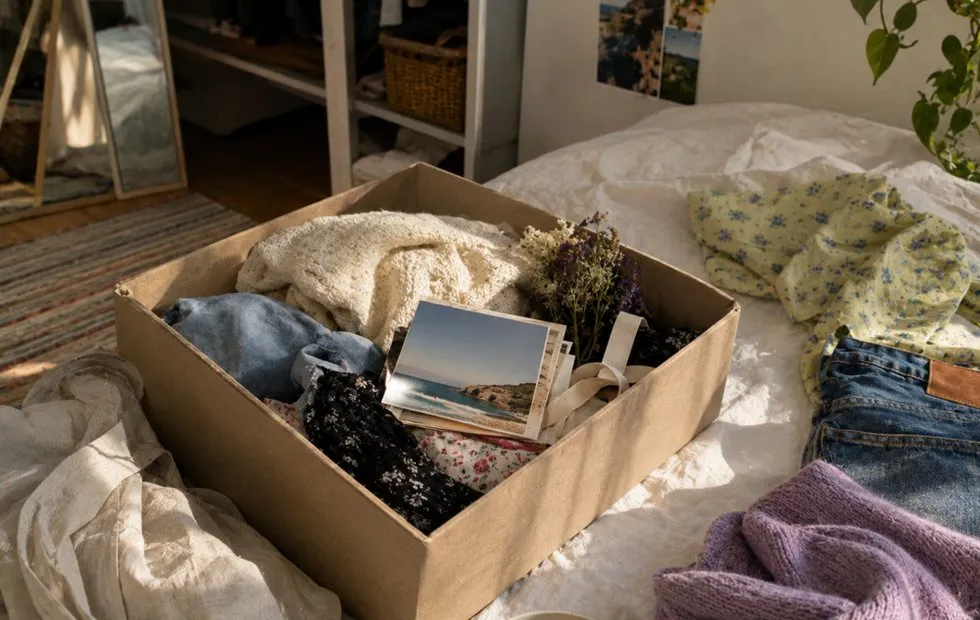
Before storing clothes or shoes for an extended period, it’s advisable to tidy them up first. Shoes are cleaned and thoroughly dried, while outerwear is cleaned if necessary and stored in a closet or suitable cover. Only the items that will truly be needed in the coming days should remain in the entryway.
A simple rule works particularly well: the entrance should display everyday items, not the entire wardrobe at once. This makes cleaning easier and helps locate needed items more quickly.
Temporary items need a deadline, not just a hook
The most subtle source of clutter are items that are officially considered temporary. Returns packages, shipping boxes, clothes that need to be taken to the dry cleaner, items for relatives, or a bag meant for a country house. They are deliberately left by the door to avoid being forgotten, but precisely because of this they can remain in one place for weeks.
Instead of storing them permanently, it’s better to set a specific deadline for removing such items from the apartment. If a package is left by the door, it should be sent out with the next available opportunity. If this isn’t possible today, at least know exactly when it will be taken out.
It’s useful to categorize temporary items using a simple principle:
- Items that will be taken away today or tomorrow can be left in the exit area;
- Items that will be needed later are better removed from the passage;
- Items that have been untouched for several weeks should be reevaluated to determine if they are still necessary.
If several such packages and boxes keep accumulating by the door, it’s no longer a matter of lack of space. The temporary area has effectively turned into a storage space, so its rules need to be changed.
Designate One Spot for Everyday Trivialities
However, it’s not necessary to hide everything in the entryway. Keys, a transit pass, headphones, a dog leash, or the bag used every day when leaving home should logically be kept right at the entrance. Problems arise when each small item has several possible locations.
A small tray, a closed drawer, a shelf, or a few hooks help gather daily items in one place. This way, there’s no need to check the side table, window sill, pockets of all jackets, and the adjacent room before going out.
It’s very simple to test such a system: imagine returning home normally. You open the door, put down your bag, take off your outer clothes, remove your shoes, and place your keys. All the main actions should be performed without having to search or move other items first.
Don’t Turn the Entryway into a Storage Room
After a trip from the dacha or store, it’s easy to leave a bag of potatoes, a water bottle, jars, a box of vegetables, or other supplies in the entryway. At first glance, this seems convenient—everything can be sorted out later. In practice, such items can end up stuck by the door for days or even weeks.
In addition, the entryway is not necessarily suitable for storing food. Different foods require different conditions. For example, potatoes need appropriate temperature, darkness, and ventilation, conditions that are not guaranteed near the front door. There may be temperature fluctuations, sunlight, a heating element, or a cold exterior wall nearby.
Therefore, after shopping or returning from the dacha, it’s better to distribute the food immediately: put perishable items in the refrigerator, store dry goods in a suitable place, and keep vegetables where their specific conditions are met. A spare corner by the door does not mean it is suitable for storage.
Cosmetics and documents also don’t always belong by the mirror
Hand cream, perfume, a comb, or a makeup bag often make sense on the console in the hallway—they’re convenient to use before going out. A few items that are truly needed daily can be left there. But it’s not advisable to turn this surface into a permanent storage spot for all cosmetics. Conditions near the front door can change significantly due to cold, heating, drafts, or proximity to an exterior wall. For specific products, it’s better to follow the manufacturer’s requirements listed on the packaging. The same applies to aerosols and household chemicals: they shouldn’t be stored just wherever there’s free space.
The situation with documents is even simpler. A passport, contracts, and other important papers on a side table seem convenient until the first rainy day or an accidentally spilled drink. Moreover, it’s not just residents who use the entryway—it can also be accessed by couriers, technicians, and guests.
Therefore, it’s better to store important documents in a secure place inside the apartment. Only items that are truly used regularly, such as an ID card or transit pass, should be left by the door.
Bicycles Should Not Block the Path
A bike leaning against the wall can easily become part of the entryway simply because no other place has been found yet. But even if it doesn’t bother anyone most of the time, just one ordinary return home with groceries is enough to notice the problem. The handlebars protrude into the hallway, the pedals catch on clothes, and the tires can leave marks on the wall.
If a bike has to be stored inside the apartment, it’s best to place it in a way that it doesn’t block the hallway, doors, or access to cabinets. This could be a suitable wall mount, stand, or another location where it doesn’t interfere with the main traffic flow. Before installing a mount, it’s important to consider the wall material, the bike’s weight, and the load capacity of the mounting hardware.
A common hallway or staircase landing should also not be considered an automatic storage space. Passages must remain clear, and the possibility of storing items in shared areas depends on the rules of the specific building.
It’s useful to conduct the most honest test in the entryway. Open the door, take off your jacket, put down your bag, take off your shoes, and try to move forward without moving or stepping around anything. If you have to move boxes, rearrange shoes, or squeeze past a bicycle just to get home normally, it means some of your belongings don’t belong there.
A good entryway doesn’t have to be empty and perfectly organized. It’s sufficient that it’s convenient for doing what it’s meant for: entering, exiting, taking off clothes, putting shoes away, and quickly finding what’s needed. Anything that doesn’t assist with these tasks and still remains by the door for months deserves to be reconsidered at least once.