Dark wood in a small apartment: how to add depth without losing openness
But the color of furniture doesn’t work in such a straightforward manner.
Dark wood indeed reflects less light and stands out more against a light background. Therefore, a large dark piece can appear heavier than a light piece of the same size. Yet the same contrast can give a small room what it often lacks — depth, clear focus, and separation of levels. Research on interior perception confirms a broader principle: the lightness of large surfaces affects the perception of a room’s size, with lighter walls and ceilings typically contributing to a sense of greater height. And the quantity and arrangement of furniture can also alter the subjective feeling of space.
So the question isn’t “is a dark wood piece possible for 30 square meters?” What matters more is how large it will be, what background it will be against, and what portion of the room it will occupy as a single dark spot.
A single dark dresser can make a light room feel more spacious
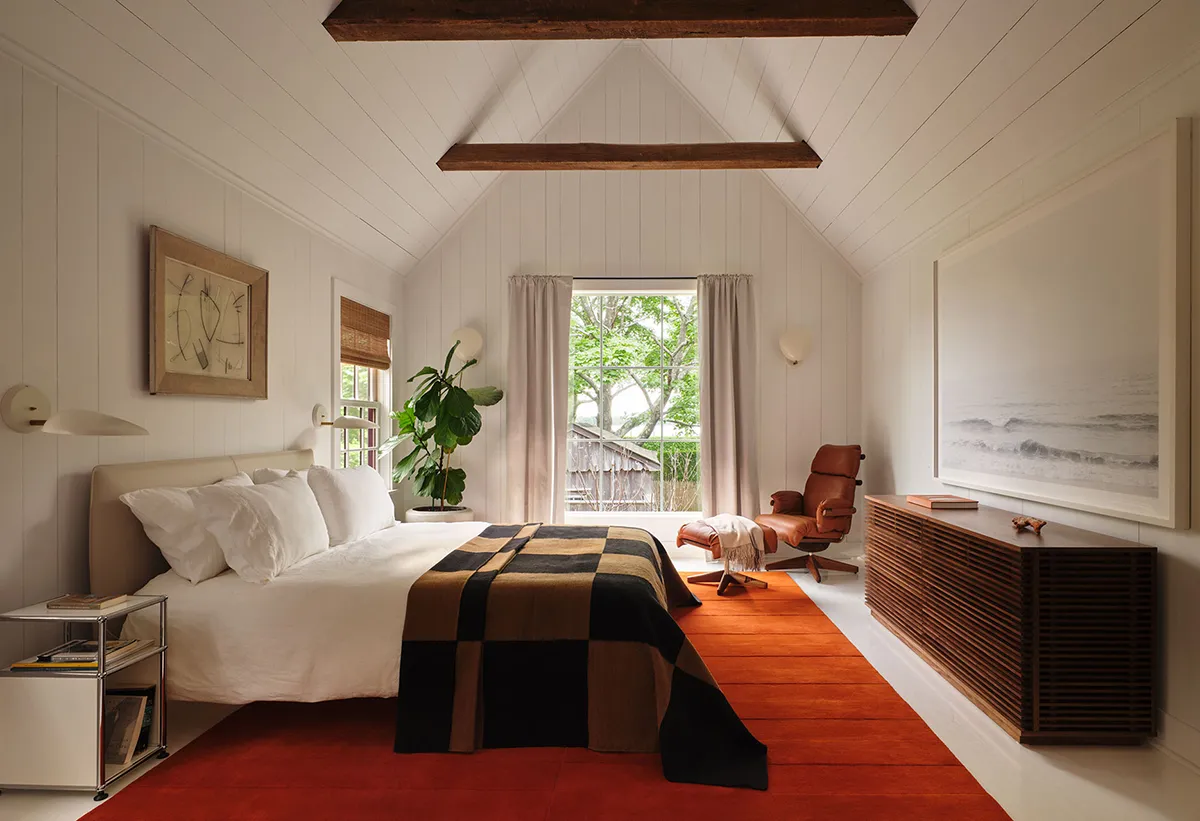
Imagine a small bedroom: milk-colored walls, light flooring, white textiles, a light-colored bed, and a wardrobe of the same color. The room appears calm. But if all the large surfaces have similar lightness, the interior can seem quite flat—there’s little for the eye to focus on between the foreground and background. Now let’s replace one item—say, a dresser—with a dark wooden one.
A contrasting point appears. The light wall surrounding it appears even brighter, the silhouette of furniture becomes visible, and the distance between the object and surrounding surfaces is clearer to discern. The dark element here does not “consume” the room but functions as a visual anchor. This is why the idea of completely abandoning dark furniture in a small space oversimplifies the issue. Light walls indeed help with spatial perception, but this does not mean that every item inside must also be light.
It’s far more dangerous to have five competing dark spots rather than one large one
A dark side table. A dark console table. Two shelves. A black frame. Another small console. Each item alone seems harmless: it’s small after all. Together, they start to clutter the room.
Recent studies on visual noise show that the perception of clutter depends not only on the number of objects but also on their spatial arrangement and the complexity of the visible scene. This is clearly evident in interiors without a laboratory setting. A single dark cabinet with a simple front appears as one surface to the eye. Seven small, contrasting objects must be noticed one after another. Therefore, a small room sometimes finds it easier to handle one fairly large dark object than a collection of tiny dark accents.
Of course, there is a limit. A cabinet made of dark veneer from floor to ceiling and from wall to wall already becomes almost a dark architectural surface. If there’s also a dark sofa opposite it, the effect will be completely different.
It’s not about the number of items per se, but about the proportion of the field of view occupied by dark surfaces.
The safest scheme — dark wood on a light background
If you want to try a dark walnut, chocolate, or nearly black wood shade, it’s easier to start where there’s still a sufficiently light surface behind the furniture.
- A dark dresser on a light wall.
- Dark headboard with light-colored fabric.
- Dining table against lighter floors and walls.
In such a composition, the edges of the furniture are clearly defined, but it does not blend into the surrounding space as a single heavy mass. It’s not necessary to make the walls white. Studies on room lighting show that lighter large surfaces are advantageous for creating a sense of height, rather than requiring an absolutely white color.
A warm gray-beige, light gray, muted sandy, or other sufficiently light background can also serve this purpose.
Dark floors and dark furniture — a different composition
- If the floor is light, dark tables or side tables stand out well from it.
- If the floor itself is a dark brown, similar furniture begins to appear as an extension of the larger dark lower area.
This isn’t necessarily bad. But in a small space, there’s a risk that the entire lower half of the room will appear visually dense. Here, a layering effect is particularly useful: a light carpet, a lighter sofa upholstery, metal or thin legs, or an area of exposed floor. There’s no need to try to match the furniture exactly to the floor color. On the contrary, two wood tones that are almost identical but slightly different often look more casual than ones that are deliberately distinct.
When mixing woods, it’s more useful to focus on the undertone. One surface may have a brown tone that leans noticeably toward red or orange, while another may lean toward grayish or a cooler shade. Undertones that are similar in nature blend more easily into a unified palette, even if the woods themselves differ significantly in brightness.
Not all dark furniture is equally “heavy”
Place two items of the same color next to each other.
- The first is a solid cabinet reaching the floor, 50 cm deep.
- The second is a table with a thin tabletop and four legs.
The color is the same. The visual mass is completely different. Therefore, in a small apartment, it’s important to consider not only the veneer pattern but also the silhouette. A dark piece on tall legs leaves the floor beneath visible. A table with thin legs reveals the space between the legs. A shelf with open sections allows the background to show through. Meanwhile, a bulky cabinet, a sofa with a floor-length base, or a wide, solid side table create a unified volume.
Dark wood works particularly well in small spaces when the piece has air within its own silhouette. Conversely, a very light but excessively large sofa that covers half the room won’t become visually lighter just because of its beige upholstery.
The scale of furniture remains the scale of furniture.
Daylight determines the appearance of the same veneer.
A sample of dark wood in a showroom and the same material at home can appear almost like two different colors.
In a room with a large window, the texture of dark wood is quite visible during the day: the grain pattern, shade transitions, and surface reflections are all apparent. In the back of a room with only a small window, the same surface can appear almost as a uniform dark patch. This is not just a matter of aesthetics. Dark surfaces have lower light reflectivity, so they return less of the light that hits them into the room. Lighter surfaces reflect more light. This factor is also used in professional calculations for interior lighting. Therefore, special care should be taken when placing a large dark cabinet in the darkest corner of a small room.
If dark wood is desired, it is sometimes better to place it closer to an area with natural or well-designed artificial light, where the material remains wood rather than a black rectangle.
In the evening, dark wood needs light not from above but from the side
There is another unpleasant surprise: the interior looks great during the day, but in the evening, all the dark furniture seems to become twice as bulky.
The cause may not lie with the furniture itself. If the only light fixture illuminates the center of the room, cabinets or dressers against the wall end up with relatively weak lighting. Dark surfaces reflect little of this light and appear to sink visually. That’s why side and localized lighting is especially useful near dark wood: a table lamp, floor lamp, shelf light, or light that shines on the wall near the furniture.
It’s not necessary to light up the cabinet itself as if it were a showcase. Sometimes, lighting the surface nearby is sufficient. This creates a boundary, separating the wood from the background again, and prevents the corner of the room from turning into a dark area.
Before purchasing a large piece, it’s wise to evaluate a sample twice: during the day and under the evening lighting that the family actually uses.
It’s better to choose warm or cool tones based on the wood’s actual appearance rather than its name
The word “nut” in the catalog does not guarantee a specific color. One dark surface is noticeably reddish, another is almost chocolate-colored, and the third appears gray-brown. Therefore, it is better to compare actual samples next to the wall, floor, and textiles rather than just the names.
If a room has many warm beige and cream tones, wood with a strong red-orange hue will enhance the warmth of the overall design. A darker, grayer veneer will create a noticeable contrast. Both approaches can work. Problems usually arise when several different brown shades, each with its own undertone, are combined in a small room, along with a contrasting floor. In such cases, the eye is exposed to too many distinct surfaces.
It’s not necessary to make everything perfectly balanced. It’s sufficient to decide which wood tone should be the main one, using the others as accents rather than new competitors.
A large dark wardrobe should be evaluated not by its front but by the entire wall it occupies
The most challenging item for a small apartment isn’t a table or dresser but built-in furniture.
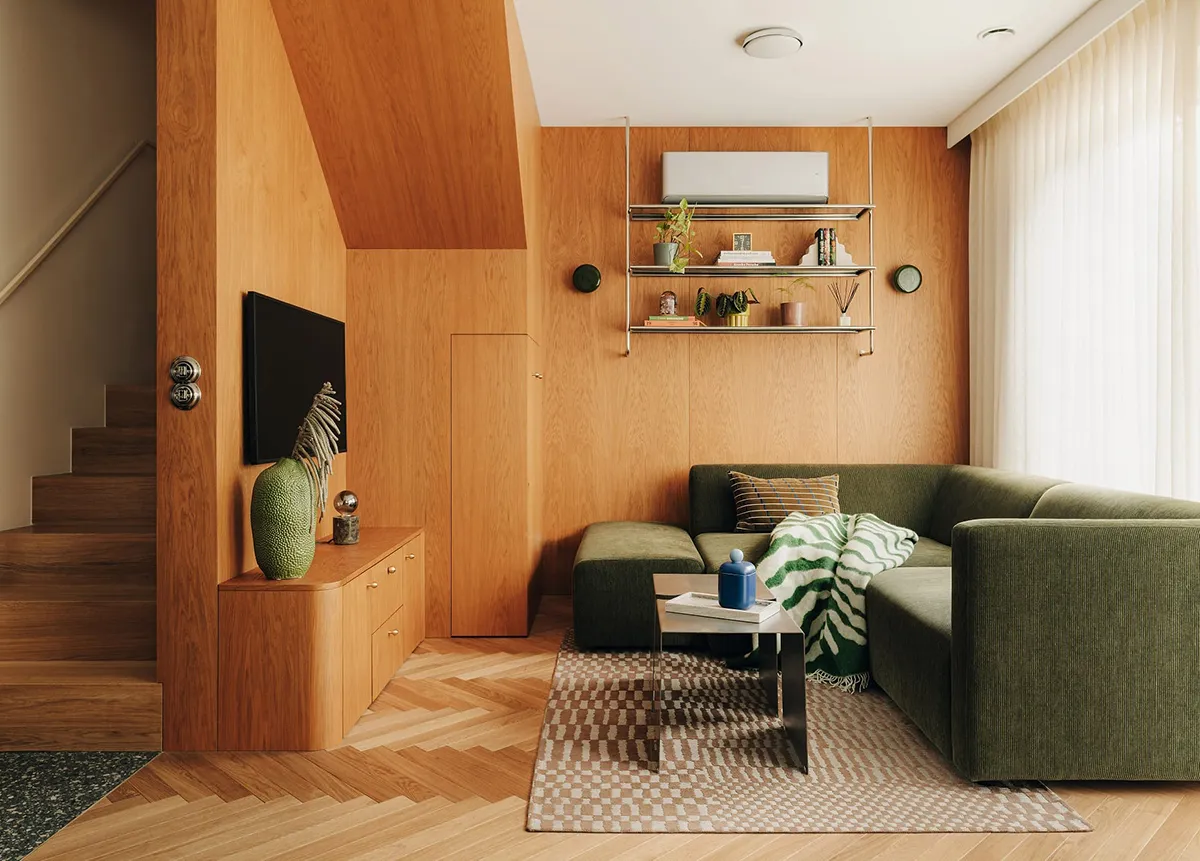
A dark wardrobe that reaches the ceiling can be very impressive. But if it takes up a four-meter wall, it’s almost no longer furniture but rather a decorative element of the room. Here, a simple calculation helps: how much of the wall will remain light after installation?
- If a dark cabinet occupies one short wall while the other three surfaces are light, it can create the illusion of a deep niche.
- If the dark panels extend to the adjacent wall, there’s a dark door nearby, and dark wood is on the floor, the space becomes enveloped by the same rich tone.
Then “adding depth” easily turns into “removing the boundaries of the dark mass.” In a very small bedroom, a compromise might be a dark cabinet only in the lower section, one dark central section, or a combination of wood with soothing light panels.
Not because there’s a correct percentage of dark wood, but because a large piece must be considered part of the room’s architecture.
You can check the dark wood even before ordering the furniture
Take a large dark blanket, cardboard, packing paper, or any material with a similar lightness, and cover approximately the area that the future item will occupy. Do not try to mimic the exact pattern of the veneer. What matters now is the texture.
If you’re planning a commode, mark a rectangle indicating its size. For a wardrobe, cover the largest possible section of the wall. Look at the room during the day, then again in the evening under normal lighting. Take photos from the entrance. It will become immediately clear what happened to the balance: whether the desired contrast was achieved or if the entire back part of the room turned dark; whether more light-colored wall space should be kept nearby; and whether the space needs lighter legs or a less bulky shape. Dark wood in a small apartment doesn’t need to be justified merely by the term “accent.” It can very well serve as the main expressive material.
But it works best when the dark item has a light background, proper lighting, and some empty space around it. In that case, the wood adds layer and depth to the room, rather than turning a small space into a collection of heavy brown surfaces.