House from Double Brick Construction by Arhitektura in Ljubljana, Slovenia
Project: House from Double Brick Construction Architects: Arhitektura – Urbanism and Architecture OfficeLocation: Ljubljana, SloveniaArea: 5,920 sq ft
Year: 2020Photography: Miran Kambič
House from Double Brick Construction by Arhitektura
Arhitektura – a studio from Slovenia, designed a house from double brick construction in Ljubljana, the capital of the country. This modern house is located in a former prestigious villa district now filled with poorly maintained houses. Its cubic form stands out among overgrown lots and surrounding homes. With almost 6,000 square feet of living space, this house aims to restore the prestige of the area.
Rožna Dolina was long the most prestigious villa district in the capital of Slovenia, Ljubljana. However, its outskirts began to gradually fill with low-quality housing as early as the 1930s. Today, these poorly maintained homes are surrounded by overgrown gardens, sheds, workshops and affect the overall aesthetic, functionality, and hygienic conditions of this once important urban area. In this deteriorating district, a process of gradual re-urbanization is taking place. It began during the socialist period around 60 years ago with a large-scale demonstration of existing urban fabric and construction of new massive apartment blocks. Today, this process continues with the erection of an increasing number of new buildings, whether luxury villa blocks or individual exclusive modern villas.
A new urban matrix is forming, which will gradually grow above the chaotic suburban fabric. However, this intermediate period is full of paradoxes and gross gaps between old and new. Despite the lack of a clear spatial concept and broader strategy, the area is gradually being filled with modern objects that will improve both living conditions and urban environment. The new semi-detached residential house is located on a long and narrow plot of land between old adjacent residential houses. The new house was designed to accommodate two large families of five people each and is built on the site of a previously demolished residential building with low quality and value.
The unusual plot prompted the design of a unique narrow floor plan that is only 6 meters wide and 30 meters long. The building height is 9 meters with three functional floors. It houses two identical living spaces, each with a useful area of 170 square meters. The spaces are arranged one after another, with a shared parking area in front of the building facing the access street. The ground floor features a large living room with an adjacent kitchen.
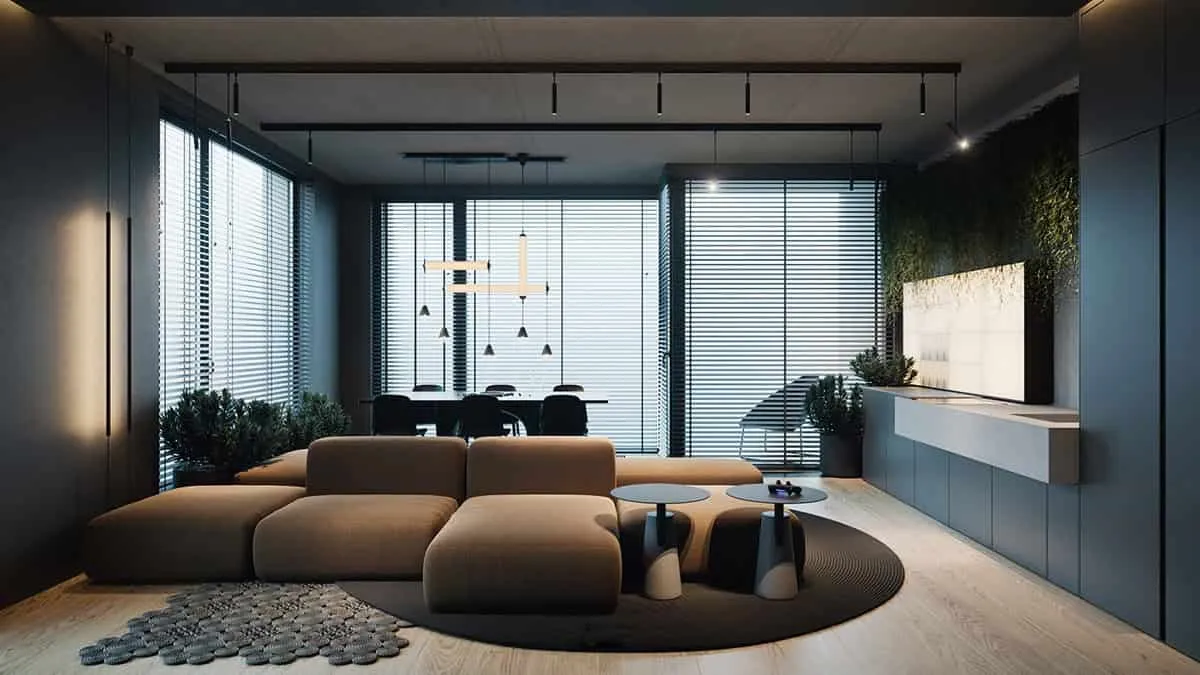
Enclosed by glass panoramic windows, the living spaces are well-lit and can be fully connected to an external atrium 30 meters long and 6 meters wide. The first floor is designated for children's rooms, their bathrooms, and a study. The main bedroom with adjacent spaces is located on the upper floor, with access to a large rooftop terrace. The house acquired its characteristic and recognizable silhouette through the arrangement of functional zones.
Visually, the building is designed as a monolithic, materially unified cube sculpturally modified according to the principle of subtraction. The dark brown brick cladding gave the house the desired material uniformity and massiveness. Various rhythms of windows and alternating open and closed surfaces on facades do not destroy the perception of building volume, as it is primarily perceived in scale as its texture rather than structure.
The further placement of the building within a broader urban environment will be the result of negotiations with neighbors who may follow suit and replace deteriorating buildings, improving the overall urban atmosphere including such shared aspects as underground electrical wiring, sidewalk repairs, road maintenance, fence fixing, and garden updates.
–Arhitektura