Tips for Choosing the Perfect Bunk Beds for Your Kids
When floor space in a home is at a premium, sharing a bedroom often becomes a practical necessity. For growing families, learning how to make your small home look spacious and beautiful frequently begins with vertical furniture planning. Bunk beds offer an ingenious architectural solution, taking advantage of vertical volume so you can accommodate multiple sleepers, preserve open play space, and maintain an organized, uncluttered interior aesthetic.
Selecting the right setup, however, involves far more than simply finding a style that matches your child’s favorite color. A well-chosen bunk bed must balance structural safety, spatial proportions, ergonomic comfort, and long-term modular adaptability. Navigating weight capacities, clearance dimensions, ladder styles, and regional safety mandates can quickly overwhelm even the most design-conscious homeowner. This comprehensive guide walks you through essential safety regulations, ceiling height calculations, material choices, and layout configurations so you can select the perfect bed for your children’s room.
Quick Bunk Bed Guide
- Reserve the top bunk exclusively for children aged six and older to prevent serious nighttime falls.
- Maintain at least five inches of guardrail clearance above the top of your upper mattress.
- Leave 30 to 36 inches of open space between the upper mattress surface and the ceiling so sleepers can sit upright comfortably.
- Check that your lower bunk offers at least 30 inches of vertical headroom to comfortably accommodate daytime sitting and reading.
- Invest in solid wood construction with mortise-and-tenon or heavy steel bolt joints to eliminate squeaking and structural sway.
- Choose modular convertible frames that detach into two separate platform beds to maximize long-term utility as your family grows.
How to Choose the Best Bunk Beds for Kids: A Practical Design and Safety Guide

Understanding Bunk Bed Safety Standards and Age Guidelines
Never place a child under six years old on the upper bunk, and maintain at least five inches of guardrail height above your mattress surface to prevent accidental falls.
Safety is the foundational requirement of any elevated sleep structure. Children treat their bedrooms as creative playgrounds, which means elevated platforms will inevitably endure enthusiastic play, climbing, and shifting weight loads. As a parent, establishing strict safety parameters before introducing a bunk bed into your home protects your children from preventable falls and structural accidents.
What Age Is Safe for Top Bunk Sleeping?
A widespread misconception among parents is that toddlers and preschoolers can safely navigate an elevated bed once they leave a crib. Official safety standards strictly prohibit children under the age of six from sleeping on the upper bunk. The United States Consumer Product Safety Commission (CPSC) mandates prominent warning labels specifying that children under six years old lack the coordination, judgment, and spatial depth perception needed to safely navigate an upper mattress and ladder.
International authorities take an even more cautious approach. For instance, the Australian Competition and Consumer Commission (ACCC) advises that the top bunk is not recommended for children under nine years of age. If your children are very young, the safest configuration is to place the older child on top only after their sixth birthday, while reserving the lower bunk or a ground-level trundle for the younger sibling.
Guardrail Dimensions and Mattress Thickness Safety Limits
Upper bunk falls rarely happen because a child climbs out during the day; they most frequently occur when a child rolls over during deep sleep. To protect the sleeper, recognized bunk bed safety standards require continuous guardrails along all sides of the top bunk. If the bed is placed directly against an interior wall, the wall-side rail must still be installed unless the gap between the wall and frame is less than 3.5 inches, preventing head entrapment.
The vertical distance between the top of the mattress and the top edge of the guardrail must be at least five inches. Parents often purchase overly plush, deep-pocket innerspring mattresses that compromise this defensive barrier. Always check the manufacturer’s maximum mattress thickness label before purchasing bedding. In most cases, upper bunks require low-profile mattresses measuring between six and eight inches in depth to preserve the required guardrail height.
Room Measurements: Bunk Bed Ceiling Height Clearance and Layout Planning
Ensure a minimum vertical clearance of 30 to 36 inches between the mattress top and the ceiling so your child can sit up safely without hitting overhead hazards.
Even the most stunning architectural bunk bed will feel claustrophobic and hazardous if the room lacks appropriate proportions. Before ordering furniture or browsing retailers like Amaze Furniture to explore timber styling ideas, measure your bedroom across three axes: ceiling height, floor perimeter, and mechanical clearance pathways.
Bunk Bed Ceiling Height Clearance
Ceiling height dictates which bed profiles your room can safely handle. Standard residential ceilings in modern construction typically measure eight feet (96 inches), whereas older historic homes or basements may drop to seven feet or lower.
Safety guidelines recommend a minimum clearance of 30 to 36 inches between the top surface of the upper mattress and the ceiling. This vertical pocket ensures that an older child or teenager can sit fully upright without hitting their head. When calculating your vertical envelope, account for the following elements:
- The total height of the bed frame, from floor to the top beam.
- The thickness of the upper mattress resting on the support slats.
- The drop distance of ceiling-mounted fixtures, including recessed lighting, hanging pendants, and overhead ceiling fan blades.
Never position an elevated bunk within reach of a ceiling fan. Rotating blades present an immediate head and limb injury risk for a child sitting or standing on the top level. Maintain at least three feet of horizontal clearance between the upper perimeter and any rotating fixture.
Headroom Clearance Between Bunks
The space between the bottom mattress and the upper frame determines the day-to-day comfort of the lower sleeper. Compact frames designed for small rooms often reduce this opening, forcing older children to stoop when sitting in bed to read or relax.
Look for frames that provide at least 30 inches of open vertical space between the top of the lower mattress and the underside of the upper platform. Adequate headroom allows the bottom bunk to double as a daytime reading couch, maximizing the functional living area of a compact bedroom.
Comparing Popular Bunk Bed Configurations
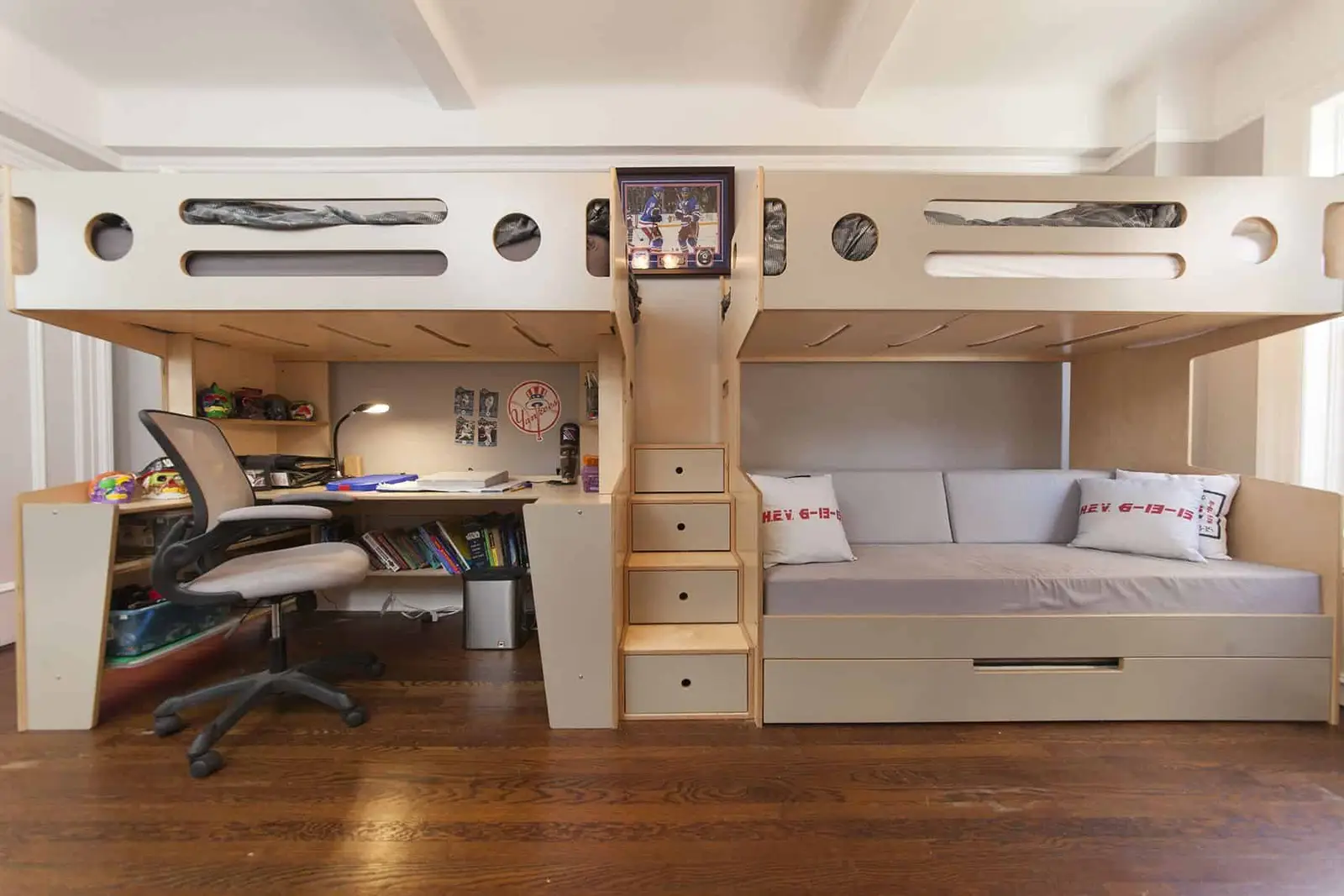
Bunk beds have evolved from utilitarian camp furniture into versatile, multi-functional design statements. Choosing the ideal configuration depends on your floor area, the age gap between your children, and your daily storage demands.
Selecting the right silhouette balances sleeping capacity with the natural circulation pathways of your bedroom. Here is how the most common configurations compare in modern interior planning:
| Configuration | Mattress Setup | Best Suited For | Key Architectural Benefit |
|---|---|---|---|
| Twin Over Twin | Two standard twin mattresses | Siblings close in age sharing small rooms | Smallest footprint; maximizes remaining floor area |
| Twin Over Full | Twin top, full bottom | Older siblings, guests, or mixed-age children | Stable wider base; comfortable lounge area on bottom |
| Loft Bed with Desk | Single elevated twin or full | Only children, teens, or dedicated study rooms | Frees entire lower footprint for a workstation or dresser |
| Bunk Beds with Storage | Twin or full over built-in drawers | Rooms lacking closet space | Eliminates need for an extra freestanding dresser |
| Convertible Bunk Beds | Separable frames (twin or full) | Long-term planning across changing residences | Splits into two standalone platform beds later |
Twin Over Full Bunk Bed Configurations
The twin over full bunk bed is one of the most flexible options for growing families. By placing a larger full mattress beneath a twin upper bunk, the frame naturally forms a stable, pyramid-like footprint that anchors the room visually.
This layout accommodates an older child who has outgrown a narrow twin mattress, provides a comfortable spot for storytime, and offers ample space for hosting visiting guests or relatives. If you have the floor width to accommodate the extra 15 inches of width that a full mattress requires, this configuration offers exceptional versatility.
Bunk Beds with Storage and Integrated Trundles
Clutter management is one of the biggest challenges in a shared bedroom. Many modern manufacturers incorporate deep under-bed rolling drawers or pull-out trundle beds directly into the lower frame. Bunk beds with storage turn underutilized floor space into hidden utility zones for extra bedding, clothing, and toys.
If your children frequently host sleepovers, a pull-out trundle mattress underneath the lower bunk provides a third sleeping surface without requiring permanent floor space. When not in use, the trundle slides flush with the baseboard, maintaining clean room lines.
Ladders vs. Integrated Staircases: Accessibility and Traffic Flow
The route a child takes to travel between the floor and the upper platform affects both daily safety and room ergonomics. The two primary options are vertical ladders and integrated staircases.
Ladders remain the standard choice for space-constrained bedrooms. Straight vertical ladders attach flush against the frame, requiring zero additional square footage. However, vertical climbing requires balanced coordination and can prove difficult during midnight bathroom trips. Angled ladders offer a gentler slope and wider rungs that make ascent easier, but they protrude 10 to 18 inches into the room, potentially obstructing walkways or adjacent drawer units.
Integrated staircases provide the safest, most stable climbing surface. Many homeowners explore creative bunk bed hacks or opt to build custom bunk bed stairs to improve accessibility. Staircases offer deep structural treads, supportive handrails, and built-in side cubbies that double as high-capacity toy and book storage. The trade-off is footprint: a staircase unit adds roughly two to three feet of length to the overall frame, making it best suited for longer rectangular rooms.
Material Selection: Solid Wood vs. Metal Frames
Material construction directly governs a bunk bed’s structural rigidity, acoustic performance, and visual presence. While budget models frequently utilize lightweight materials, investing in higher-grade construction ensures your furniture remains safe and wobble-free through years of use.
Solid Hardwoods and Quality Softwoods
Solid woods like rubberwood, birch, maple, and knot-free pine represent the gold standard in nursery and juvenile furniture. Solid timber provides exceptional structural weight, dense screw-holding capacity, and a warm, tactile finish that complements diverse interior decor styles.
Wood absorbs sound and vibration better than hollow materials, virtually eliminating the annoying creaks that occur when a restless sleeper shifts during the night. Inspect joint connections when selecting wood beds: look for mortise-and-tenon or heavy steel bolt construction rather than basic wood screws and glue, which can loosen under lateral movement.
Metal Tubing and Industrial Frames
Metal bunk beds offer a sleek, lightweight profile suited for industrial, minimalist, or contemporary aesthetics. Quality metal frames utilize heavy-gauge powder-coated steel tubing that resists scuffs, scratches, and moisture damage.
While metal beds are often more budget-friendly and easier to disassemble during moves, they have distinct practical drawbacks. Thin-walled metal tubes can feel cold to the touch, and ladder rungs may be uncomfortable on bare feet. Over time, friction between metal joints can create noticeable squeaking unless bolts are periodically tightened and fitted with rubber isolation washers.
Choosing Convertible Bunk Beds for Long-Term Flexibility
Select convertible bunk beds that uncouple into two standalone platform beds to adapt to changing floor plans and growing children over time.
Children grow rapidly, and family living arrangements evolve over time. Purchasing a fixed bunk bed that only works while your children are young can lead to early replacement costs once they reach their teenage years.
Convertible bunk beds for kids provide the best return on investment by allowing the stacked unit to uncouple into two freestanding platform beds. When your children eventually move into separate bedrooms, or when family routines change, you can simply unbolt the top bunk, detach the safety rails and ladder, and place two identical beds side by side. Exploring innovative modern bunk bed designs that highlight modular transformation ensures your furniture investment serves your home across multiple life stages.
Creating a Functional, Cohesive Shared Bedroom
Integrating a large bunk bed into a shared room requires careful attention to traffic patterns, natural lighting, and individual autonomy. Because the bed represents the visual anchor of the space, its placement dictates how comfortably the rest of the room functions.
Start by evaluating traffic flow. Ensure that closet doors, entryways, and under-bed drawers can open completely without striking the bed structure or ladder base. If you are struggling with a challenging floor plan, reviewing practical strategies on how to fit two beds into a small room can help you test alternative angles, such as L-shaped corner layouts.
Next, consider individual zones of privacy and comfort for each child:
- Independent lighting: Install separate low-voltage LED reading sconces or clip-on lamps for each bunk so one child can read without keeping the other awake.
- Bedside storage pockets: Upper bunks lack nightstands; mount a sturdy floating shelf, hanging caddy, or wall pocket so the top sleeper has a dedicated place for a water bottle, glasses, and a book.
- Bed-making ergonomics: Bunk beds can be notoriously difficult to dress. Opt for zipper bedding, lightweight quilts, or fitted comforters that eliminate the struggle of tucking sheets against tight wall corners.
- Acoustic and visual balance: Use soft area rugs, acoustic wall panels, or subtle bunk curtains to absorb sound and give each child a sense of ownership over their personal sleeping retreat.
Whether you are renovating an entire room or selecting finishes while building a personalized home, treating the bunk bed as an architectural centerpiece creates a harmonious environment where siblings can comfortably live, rest, and study together.
Final Takeaways for Choosing the Right Kids’ Bunk Bed
Selecting the best bunk bed comes down to pairing strict safety precautions with smart spatial planning. Prioritize certified frames that meet CPSC safety standards, enforce the six-year-old minimum age limit for the upper bunk, and maintain at least 30 to 36 inches of open headroom between the top mattress and the ceiling.
By opting for durable solid materials, low-profile mattresses that preserve guardrail protection, and modular convertible frames that split into standalone beds, you create an inspiring, space-saving shared bedroom that keeps your kids safe today and adapts seamlessly to their needs for years to come.